Collaborations
Working together on meaningful creative projects, from studio residencies to large-scale commissions to community-based workshops.
What Collaboration Means Here
We work with other artists, cultural institutions, and organizations on projects that push the studio practice in new directions. Whether it's a shared exhibition, a residency, a commissioned series, or teaching—every collaboration begins with the same question: what can we learn from working together?
Types of Collaboration
We engage with collaborators across several different frameworks. Each has its own shape and timeline, but all of them center on the work itself and the relationship that develops through making it together.
Getting Started: How We Work with Partners
The first conversation is usually exploratory. We talk about what you're imagining, what the constraints are, what success looks like. We tell you about our process, our timeline, and what we can realistically commit to. From there, you'll know whether this feels like a fit.
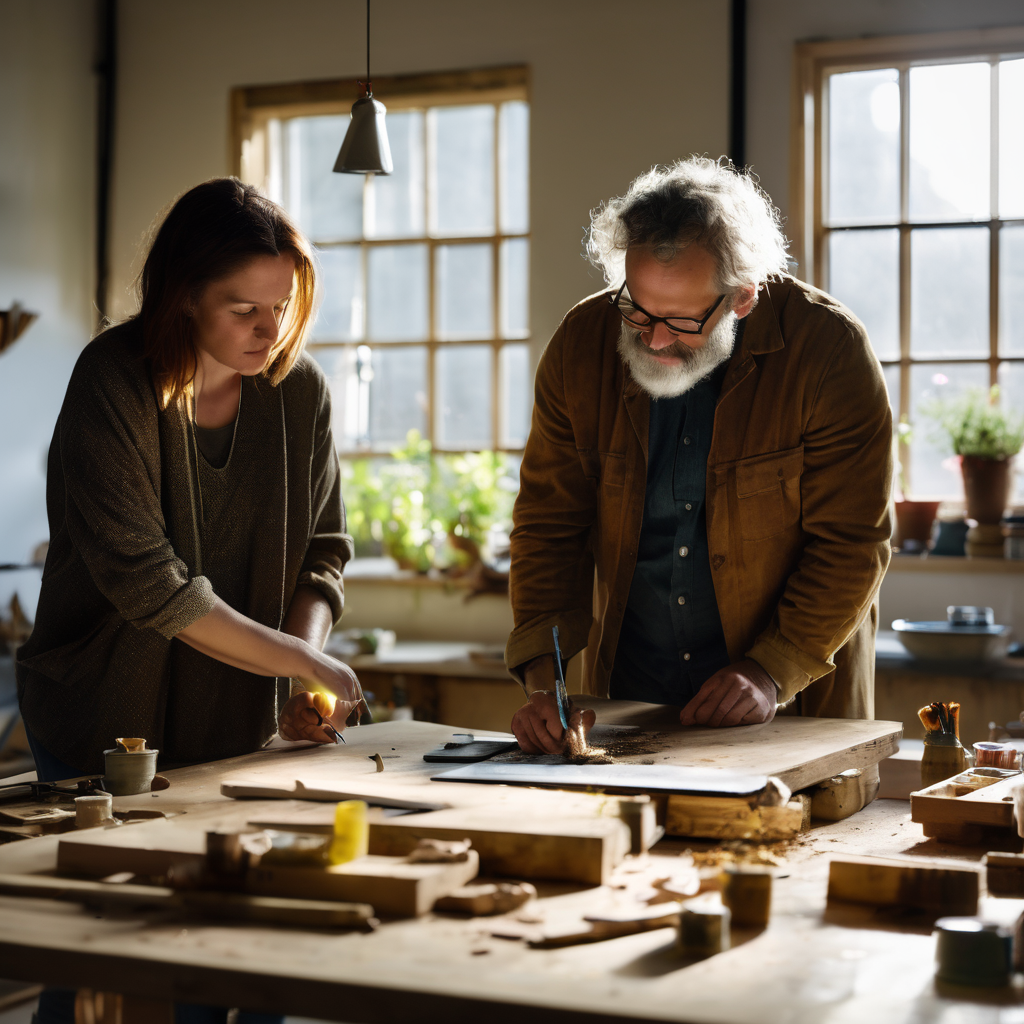
Making It Happen: The Collaboration Process
Every project moves through a similar sequence of stages, though the time spent in each varies. This table breaks down what happens at each step and what you'll see from us at each stage.
| Stage | What We Do | What You'll See |
|---|---|---|
| Proposal & Planning | Define scope, timeline, materials, and budget. Discuss the vision and any constraints. Document all of this in a contract. | Written proposal outlining the project, timeline (usually 4-16 weeks), and our role in it |
| Exploration & Experimentation | Make early sketches or proofs. Test ideas. Show you where we're heading and ask for feedback. | Progress updates, initial sketches or studies, conversation about direction |
| Development | Build toward finished work. Make adjustments based on feedback. Document the process as we go. | Work-in-progress images, studio notes on decisions being made, revision rounds as agreed |
| Completion | Finish and deliver the work. Provide documentation and materials as promised in the contract. | Finished work, archival materials, signed edition information, process documentation |
Collaboration Models
Depending on what you're looking for, we can work under different frameworks. Here's how each one works and what each requires from both of us.
| Model | Time Investment | Creative Input | Typical Duration |
|---|---|---|---|
| Artist Residency | Full-time studio access for agreed period | Partner defines the theme, artist brings their own practice | 2 weeks – 3 months |
| Commissioned Series | Part-time focused project work | Collaborative from initial concept through final pieces | 6 weeks – 6 months |
| Public Workshop | Teaching role within the studio | We design curriculum, participants bring their own creative goals | 1 day – 4 weeks |
| Institutional Contribution | Varies widely | We contribute expertise or finished work to a larger project | Varies by project |
| Cross-Studio Exchange | Usually intensive but time-bounded | Each studio contributes its own perspective and methods | 2 weeks – 2 months |
Learning from the Process
One of the core values of any collaboration is that we all come out of it knowing something we didn't before. We document process heavily—through writing, photography, and sometimes video—because that's what makes the collaboration meaningful beyond the finished work itself.
What Artists Are Saying About Their Process
One resource for understanding how collaborative creative practice actually works is hearing directly from other artists. This video brings together multiple perspectives on developing artistic voice through collaborative work and creative exchange.
Why It Matters
Collaboration isn't a shortcut or a compromise—it's an expansion. When you bring your perspective and we bring ours, when both of us are committed to something outside ourselves, that's where the real work happens. We're always interested in talking with artists, curators, institutions, and creative people about what that might look like for you.